|
| Info on the SA outback |
A
fter spending the night at the well set up rest area on the South Australian / Northern Territory border (along with another five groups of campers) we continued down the Stuart Highway. Our first stop was at Marla which has few facilities really – a roadhouse with fuel, a small supermarket (which we didn’t go into) and a camping ground which looked pretty good. There were other service businesses behind the roadhouse so really it was well set up. We stopped and had lunch and chatted to another couple who had blown the injectors in their new vehicle, also towing a caravan. They were travelling with another couple and were thinking that their four week holiday had just reduced to three days.
 |
| Travelling the Stuart Highway in SA |
The Stuart Highway is pretty boring to drive with desert conditions on both sides of the highway. We stopped off at Cadney Homestead which is another roadhouse and if you have been following our blog you will know that we normally stop when there is any kind of roadhouse or similar to break the monotony. We spoke to one couple who said that driving the outback is really about filling the fuel tank, driving all day, then filling the fuel tank again.
 |
| Cadney Homestead Roadhouse |
The Cadney Homestead offered coffee and homemade cake for $4 – we thought this was too cheap to be real but then found that it was instant coffee and a very thin layer of plain cake so we gave that a miss. We can do better than that from supplies in the caravan.
As we neared Coober Pedy we saw the sign post to “The Breakaways”. We had been told not to miss this so even though we had the caravan hitched we took the gravel road as it indicated only 11 kms. We were so pleased that we did. This area was originally a sea many millions of years ago. It consists of colourful low hills which have broken away from the Stuart Range. There are two lookout points but we only viewed from one – it was so windy that I was afraid that the caravan would be blown off the point! We then took the road down to the Dog Fence which goes past the hills called “Salt and Pepper” as one is white and one is brown. These hills have been used in films and advertisements as they are so unique. Panorama Hill which is also in this area featured in Mad Max Beyond and other movies. We were initially unsure about taking this road as we were uncertain about the gravel and how rough it would get with the caravan hitched. But the thought of seeing the Dog Fence won out and we continued, uncertain how long we would need to go before seeing the Dog Fence. We were rewarded quite soon. The fence is a two metre high wire barrier which stretches over 5,300 km across three States to protect the sheep country in the south from the native dog, the dingo. The desert stretching out from the fence is nicknamed “moon plain” and it too has been the scene for numerous movies. We were very fortunate that the road was very dry (as it becomes 4wd only after rain when it apparently gets very boggy) and we were able to follow the fence until it met the Oodnadatta Track which led into Coober Pedy. We were really glad that we didn’t have to do the return journey as diesel was getting really low in the tank and we didn’t want to finish the day stranded.
Our first sights of Coober Pedy were amazing. We have never visited a place where there are large mounds of dirt in every direction and strange looking entries into the hillside. As we drove through the town there were only a very few “normal” shops but fortunately a couple of petrol stations! In some ways it felt as though we were back in Alice Springs as the locals were “sitting around” the pavements etc.
We set up camp at the Hutchinson Memorial and had the outback to ourselves until we were joined by another group of campers. It was still pretty amazing.
The next morning we headed to the information centre to find out as much as we could about what to see. The centre was very helpful and had self drive maps and brochures as we were loathe going on an organised tour. Churches were first on our list and we went to the Serbian Church – to say we were amazed is an understatement. We have never been inside a purpose built underground building before. The outside of the church was flat against the side of the hill and the door led into a passage leading down. Inside there was a most beautiful chapel with stained glass windows with lights behind them (as they were not going to the outside), carvings etc. The roof and the walls of the church were the coloured stone of Coober Pedy. This was not built in but the natural stone that the church had been carved into. This is really difficult to describe and if you can’t get to Coober Pedy to look for yourself I can only suggest that you “Google” this. Coober Pedy
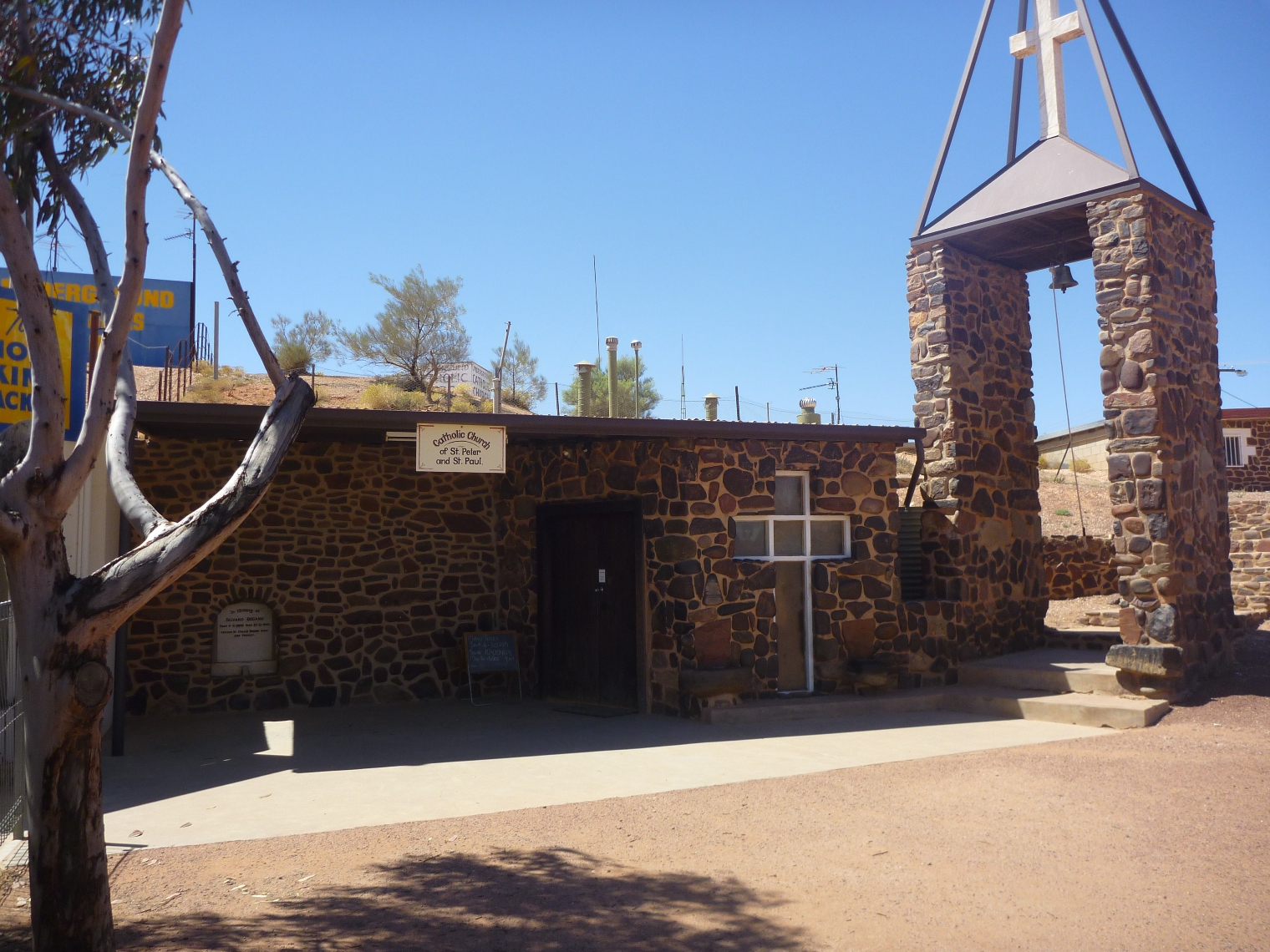
The Catholic Church was next. The churches are all open to the public and in all we went to four – more visits to a church in a couple of days than the last few years! Again the Catholic Church is a “dug out” and is beautifully presented. There are no windows in any of the dugout buildings and they keep a constant temperature of around 23-25 deg day and night throughout the year which is amazing when you think that between March and November the days are warm but the desert nights are very cold (as we have experienced!), and from December to February the summer temperatures range from 35 deg C in the shade upwards. The annual rainfall is very minimal at around just 175 mm (5 inches) per annum.
Next door to the Catholic Church is a motel and backpacker inn with shop. This facility has accommodation for 170 people all underground. We enjoyed visiting the various underground shops. At the underground bookshop there was a sign on the door saying “closed – out refuelling the aeroplane”. We weren’t sure if this was correct but when we returned later the shop was open so can only assume it was.
We then visited the Desert Cave Hotel which has an underground information area, bar, shops and cafe. We visited here for some time, although giving a miss on the bar, but they made lovely lunch!
We were still struggling with the thought that people live underground. Coober Pedy has about 3500 with about 60% of these being European migrating to Australia from eastern and southern Europe after the Second World War. Apparently there are more than 45 nationalities represented and there are numbers of clubs and churches etc in the area for the various ethnic groups. We understand that 80% of the population live in “dug outs” underground. We were told that it is cheaper to live underground than have to pay the cost of electricity to power heating and cooling. Whether this is true, we don’t know. One private property is open to the public for viewing so we took this opportunity. The property was originally dug out by three women and is now lived in by a couple who open the property. The kitchen, dining room, three bedrooms, wine cellar and lounge are all underground. This is joined by an above ground pool and entertainment area. We were told that the pool and adjoining area were originally uncovered but due to evaporation it was necessary to cover the pool.
Coober Pedy is the opal capital of the world! There is evidence of mining in every direction that you look. We paid a visit to the Old Timers Mine and took the self guided walk down into the mine itself. This was underground and very narrow in areas and is set up like a museum with models. It was really interesting. In addition to the mine there was a dug out from 1921 and also an underground home for viewing that is no longer lived in.
We were not completed with churches yet and the Revival Centre was next as it was next door to the Old Timers Mine. Again we were amazed at the interior of this church and the adjoining Sunday School area. The Comfort Inn accommodation was next door (or really just a continuation of the hill) and again all the accommodation was underground. It is really amazing!
Saturday morning saw us ready for more sightseeing but first we had to fill the caravan with water. Coober Pedy has the best system we have yet seen for caravaners – pay twenty cents for thirty litres of fresh water pumped with a high pressure pump. We were more than happy to pay sixty cents to refill our tank.
There was one more church to visit and this was the Catacomb Church (Church of England). We were lucky enough to meet with the relieving minister who was able to explain the church to us. She was a delightful lady and we enjoyed our chat. The rectory next to the church looked a small opening in the hill but she explained that it had five bedrooms – if you look up the hill you can see the vent holes and this gives you an idea of how far back the dugout goes. Peter said after we left her that he thought her next question would be about us attending the service tomorrow. (Sunday) He certainly felt that it was time to be out of there!
We then headed to the golf club – you picture a “normal” golf club facility with beautifully groomed greens. With this one there was nothing green to be seen - $10 green fees and $10 club hire would give a unique experience if you were a golfer. You will just need to look at the photos to see what playing golf in Coober Pedy is all about.
Our last planned sightseeing was to an opal mine – we went to Tom’s Working Mine and took the guided tour. A young lady named Jo was our tour guide – she along with her father and two others work the mine at least three days a week. We had our hard hats on and down into the mine we went. Jo certainly had a great knowledge of mining having mined for the last 17 years with her ex (as she described him) she could talk about and demonstrate what the various aspects of mining were. The amazing part about opal mining in the rocks is that they appear to need no shoring timers to hold the roof etc as they drill through what basically is sandstone type rock. The colours of these rocks are truly amazing. Jo showed us how they divine for the seams of gypsum; they then follow the seam of gypsum to hopefully find the opals. According to Jo you don’t make any money out of mining, in fact her statement was in the number of years that particular mine has been operating they have made $52,000 and it has cost over $400,000 to operate. Obviously you can live on love in this area!! We found the tour very interesting and well worth the $50 cost even if only for the experience of being so far underground in cavernous corridors. We could see how it could be very easy to get lost in some of the larger mines. I (Gill) was concerned that there appeared to be no health and safety regulations – no hearing protection, no glasses, and runners were worn instead of work boots, no safety vests but she did have a hard hat on!
We have met some very interesting people as we have travelled – today we met up with Nicole and Alain from Canada who are travelling in a small campervan. They were delightful to chat too – they had been visiting Toowoomba to stay with people that they had met when travelling in Canada. We exchanged names and contact details and you never know perhaps one day we may host them in New Zealand.
 |
| Arid desert for miles |
 |
| Desert as far as the eye can see |
 |
| Wide load approaching - Caterpillar machinery |
 |
| Kangaroos or wide machinery!! |
 |
| Desert in SA |
 |
| The Breakaways near Coober Pedy |
 |
| Salt and Pepper in the distance |
 |
| Colours of the Breakaways |
 |
| More colours of the Breakaways |
 |
| The Breakaways |
 |
| It was really windy at the Breakaways lookout |
 |
| The Moon Plains as far as the eye could see |
 |
| The caravan is lucky to not get blown off the lookout by the wind |
 |
| Two dogs or perhaps salt and pepper |
 |
| Aboriginal significance of The Breakaways area |
 |
| Info on The Dog Fence |
 |
| Portion of the 5500 kms of The Dog Fence |
 |
The road had been graded near the dog fence so
great as we had the caravan hitched behind |
 |
| Moon Plains |
 |
| The road wasn't on the GPS but we drove it anyway |
 |
| Tour bus |
 |
| Welcome to Coober Pedy |
 |
| The desert view from our caravan site at Coober Pedy |
 |
| Parked up for the night |
 |
| Sunset at Coober Pedy |
 |
| The desert to ourselves - Hutchison Memorial to ourselves |
 |
| Serbian underground church |
 |
Walking down the passage into the Serbian church, this is
ground out of rock by machine - the passage is not lined
with anything. They have various machine heads that make
the different shapes. |
 |
| Inside the underground church again all rock |
 |
| Interior of Serbian church |
 |
| Lead glass windows in Serbian church - Back lit |
 |
| Carved statutes in Serbian church |
 |
| Exterior of underground homes called a dug out |
 |
| Underground home |
 |
| St Peter and Paul's Catholic Church |
 |
| Interior of underground Catholic church |
 |
| Exterior of underground bookshop |
 |
| Shop was closed - out refuelling the aeroplane! |
 |
| Inside the Desert Cave Hotel |
 |
| Underground bar at Desert Cave Hotel |
 |
| Interior of underground bookshop |
 |
| Housing in Coober Pedy |
 |
| Underground flats at Coober Pedy |
 |
| Vents on roof of underground house |
 |
| Another home - see they are carving a garage for the caravan |
 |
| Lounge in underground house |
 |
| Internal of underground house |
 |
| Dining room in underground house |
 |
| Kitchen in underground home |
 |
| Views of Coober Pedy from lookout |
 |
| Signage to warn of mine dangers |
 |
| Old Timers Mine |
 |
| Opals at the Old Timers Mine |
 |
| Old Timers Mine info |
 |
| Info on the dugout home |
 |
| Children's bedroom in dugout home |
 |
| Information on dugout |
 |
| Display in another dugout |
 |
| Internal of Revival Church |
 |
| Underground home with tank, aerial, clothes line and vents |
 |
| Info on mining blowers |
 |
| Blower on display at Coober Pedy |
 |
| Dugout for sale @ $200,000 |
 |
| Photos of internal of dugout for sale |
 |
| Exterior house |
 |
| Signage at golf club |
 |
| The golf course looked like this to the left of the sign |
 |
| Hole - see the flag |
 |
| Mining alongside the golf course |
 |
| Entrance to the golf club |
 |
| Ready to tee off |
 |
| More sitting around |
 |
| Toms Working Opal Mine |
 |
| Entering the mine |
 |
Hard hat on, divining - this is a working mine the tunnels are
areas where they have prreviously tunneled for Opals not
exactly a shortage of space for movement |
 |
| A gypsum slide towards opal |
 |
| Hand mining area - note the colours |
 |
| Currently 12.42 metres below ground |
 |
| Tour guide, Jo, demonstrating drilling with power drill |
 |
| It was very physical |
 |
| Jo scooping up the sandstone |
 |
| Blower |
 |
| Outside equipment |
 |
| Tractor mounted blower |
 |
| Hoist for lifting people and gear from shaft powered from vehicle |