Tuesday, August 6, 2013

Continuing on the beach highway, Fraser Island

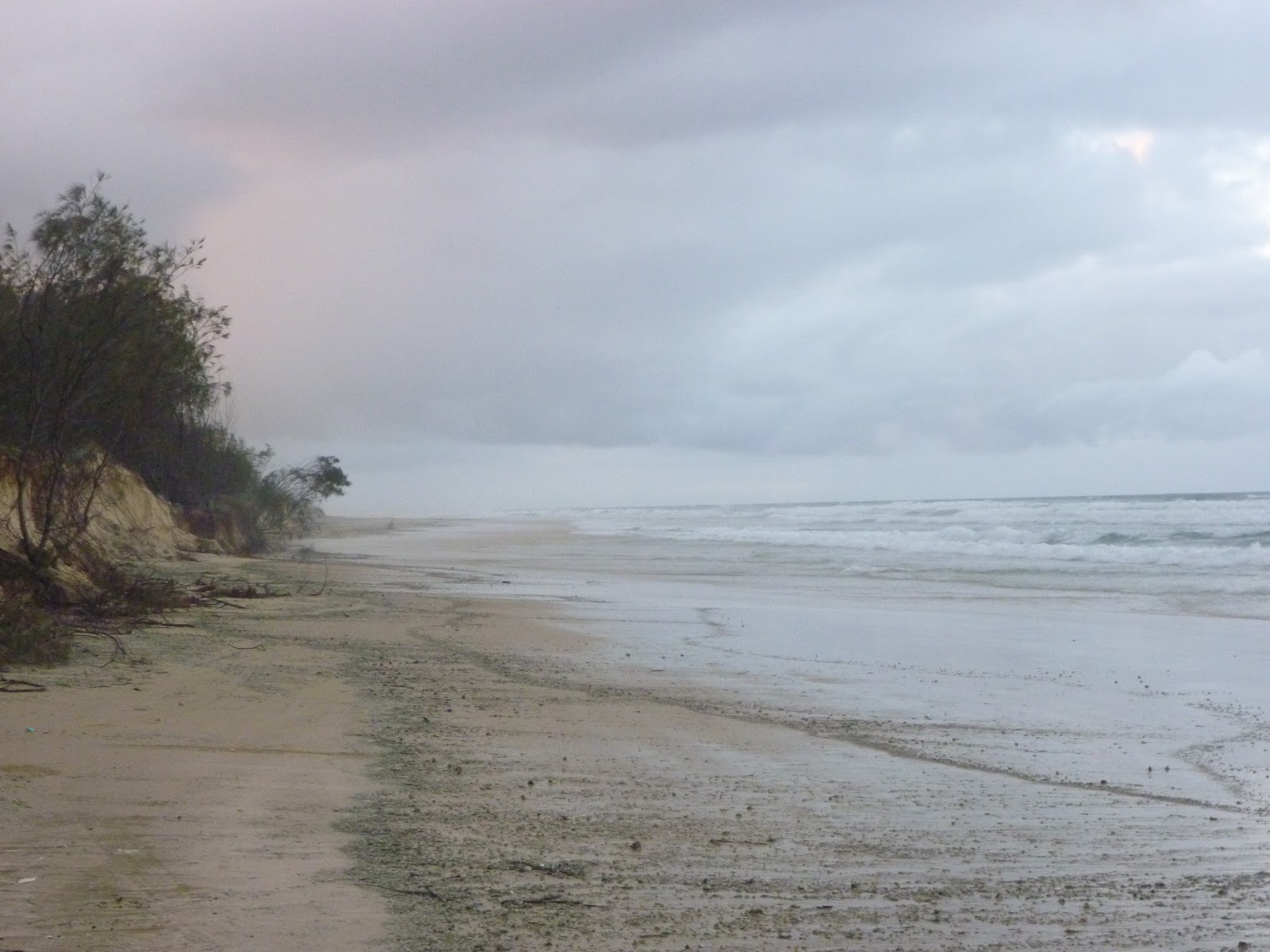
After a much longer stop at the Maheno wreck than we had initially planned we got back in the car and continued along the beach.  We followed another 4wd for a while but he was further down the beach than we were as he was obviously happy driving through the water – we preferred where possible to drive on the harder sand without the pools of water.  It wasn't always possible and in areas there were channels with running water from the sand dunes leading down which we had to cross.


There were three places I wanted to check out but we would definitely do those on our return.  Next stop was Indian Head.  Here again had to leave the beach because of the sea around the rocks and drive up the sand dunes.  Here parking was at a premium as the area was quite small and from here there is a walk to Champagne Pools. 

On the way down the board walk we eyed a rock wallaby – the first we had seen.  The view from the board walk looking back towards Indian Head was beautiful and we doubted it was ever possible to drive around the point but we were uncertain.  Soon after we had parked two or three of the 4wd tour buses had arrived so there was a constant trek of people heading down the board walk towards the Champagne Pools.  Because there is the possibility of crocodiles in the water around Fraser Island (I have no idea of how often but there are sign posts warning of the possibility) Champagne Pools are said to be the only “safe” place on Fraser Island to be able to swim in the sea.  The pools are natural bubbling rock pools – we didn’t go swimming but others did.


We decided that we would follow the track heading north and make out way to Orchid Beach for lunch.  This would be the furthest north we would go (the access along the beach does continue on to Ocean Lake but no further) and from Orchid Beach there is also a road across to the west side of the island and although there is no beach driving there is beachside camping and walking access to Sandy Cape Lighthouse near the top of the island.  Time did not allow us to venture further, and the thought of walking to the lighthouse didn’t do it either! 

We followed the track down on to the beach – it was great to leave the tour buses behind.  In the distance we could see some people fishing and a couple of vehicles did pass us as they drive either up or down the beach.  From our lunch spot on the beach we had Waddy Point to our left and Orchid Beach on our right.


There is quite a settlement at Orchid Beach with holiday homes, general store etc and is obviously a popular holiday spot.  However after a short stop we started heading back down the track, past the Champagne Pools and Indian Head on to the beach.  You soon realise that it is time to start on the trip back as the buses have left and there weren’t too many other cars around.  Remember the recommendation is two hours either side of low tide and we still had nearly 80 kilometres to drive back down the beach.

We didn’t waste any time as we wanted to stop off at two or three places on our way back down the beach.  The first was Red Canyon which could have had us thinking that we were back in Western Australia.  The diversity of this island is amazing.  Unfortunately the photos did not do these cliffs justice – the various colours were just amazing and these cliffs were beside the beach.


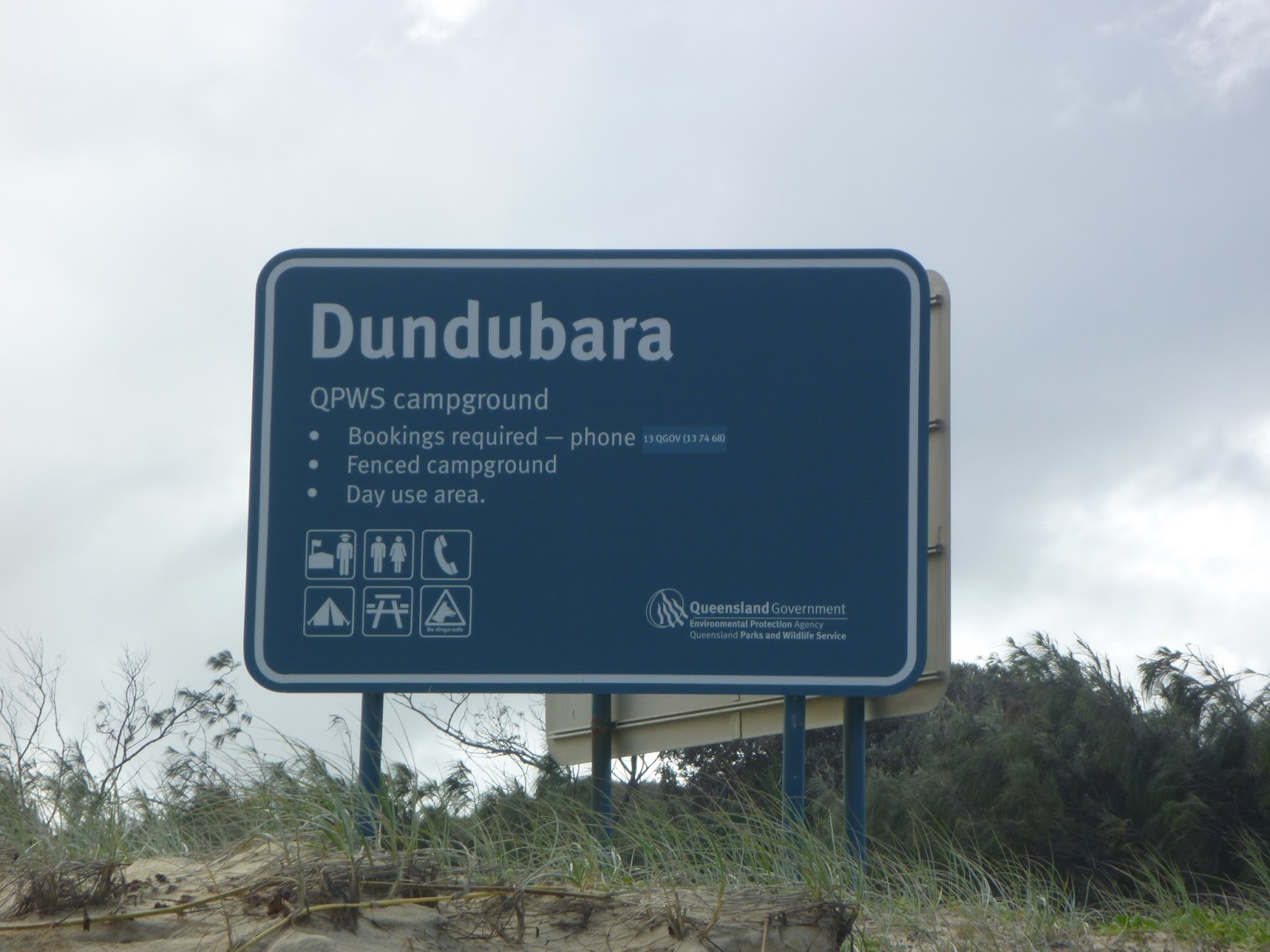
Our next stop was at Dundubara which is one of the National Park camping areas on the island.  Our first intention had been to stay here one night and then move to Central Station camping area on the second night of our stay.  I was keen to just check out the camping area as we passed.  There is a track leading up from the beach.  Both National Park camping areas (and certainly the resort where we are staying) have dingo fences around the boundaries and there is a special cattle grate to cross.  These grates have the usual metal bars but in addition they have electric wires running across the metal bars.  Certainly would keep any animal on the outside!  I didn’t take any photos of the actual camping area (my mistake now) but we were impressed with the large grassy sites and the facilities on offer.  Well worth booking, especially if rain is not forecast.  There were a few campers set up and the cleaner was there busily cleaning the facilities.  We would have been happy to have camped there.

Next stop was Cathedral Beach.  This is a privately run camping ground.  There is a general store which was really well stocked and we asked if we could walk through which the attendant said was fine.  We had met a couple on the barge crossing over and they were staying in one of the safari tents – this is a tent that is set up and has a queen-size bed with linen available for hire, chairs etc.  Pretty impressive really.  In addition there were camping sites and cabins.  The worse feature was that this camping ground, being privately owned, did not have dingo fencing and the lady said that at night it was necessary to walk with a stick to protect from wandering dingo.  I wouldn’t be too happy making the trek to the toilets in the dark if I had to carry a stick for protection.  However, dingo fencing was about to be built so this problem will soon be rectified.


Our last stop for the day was at The Pinnacles – again the diversity of this island is amazing.  These cliffs are just so beautiful and you will have to excuse all the photos but they are worth seeing and I wasn’t sure which ones to leave out.  This area is just so different to everything else on the island and yet is just up the beach from where the Maheno was wrecked and close to the two camp sites.  The colours were great.


With time now racing on it was really necessary to finish the drive down the beach and get off the sand.  It had commenced to rain lightly and the sea water was getting really high up the beach.  There are a number of 4wd vehicles swamped with water every year and we were determined that we were not going to be one of them.

It was great to see the Eurong signage and pull off the beach.  As it was raining quite consistently we returned to our room – we were so pleased that we had taken the option of staying at Eurong rather than tenting.  Fortunately the rain had held off most of the day and we had been able to visit many of the scenic spots along the eastern side of the island. 


Sunday, August 4, 2013

Driving the Eastern Side of Fraser Island

After buffet breakfast, and a check of the tides, we packed a picnic lunch and headed down the beach.  Our plan was to drive along the beach highway as far as Indian Head.  We didn’t want to cross the island again to the western side and continue to the very north of the island as time did not allow a return visit because of the incoming tide and the need to be back down at our accommodation before high tide.

At the entrance to the beach there is signage reminding visitors that the island is dingo territory.  These signs are very common on the island and seen at each of the lakes and visitor areas. 

We had not seen any dingo at all so we were so pleased to drive on to the beach and see one wandering along the sand – it was one of the few that we saw during our visit.


Obviously other visitors hadn’t seen many dingoes either as a number of 4wd vehicles had stopped on the beach and out came the cameras.  Touristy or not, we had to do the same.  The dingo wasn’t that obliging to stand still and be photographed so we had to accept what we had.  They are wild animals and visitors are asked not to get out of vehicles, approach or feed them.  We certainly followed the advice.

We continued along the beach finding it somewhat strange that we were allowed too and especially with the speed limit of 80 kilometres per hour.   The normal road rules apply on the island, with driving on the left, overtaking on the right, no drink driving etc.  There is a police station on the island and although we didn’t see the policeman out policing the beach we were advised that it is certainly a common event.  There is a reasonable amount of traffic driving up and down the beach during low tide.  Common courtesy was to indicate to ongoing vehicles that you were definitely taking the left hand side.


At some points along the beach there are rocky outcrops with sandy rock pools which had to be negotiated.  Some of these are more challenging than others.  As a general rule we followed the sandy tracks of other vehicles but sometimes these had dug out and it was necessary to take another way.  It can be a bit off-putting with the waves crashing quite close!
We had a distance of about eighty kilometres to drive along the beach from Eurong to Indian Head so we decided that the best idea would be to drive all the way without stopping and then slowly make our way back.  There was no doubting of where we should stop – the 4wd tour buses were already there.  However, there was one stop that was absolutely necessary and there were no tour buses already parked up.  As we drove along the beach I noticed what looked like a whale pulled up on the sandy bank.  I was initially sure that this was possibly a statue but it wasn’t mentioned in any of the guide books and it was whale season and people talked about seeing the whales out in the distance (we hadn’t seen any).  What we found was in fact a dead whale calf that had been pulled up on to the bank.  Not a particularly pretty sight and we had no idea, and never did find out, how it died or anything about it.  However, it was the closest we had ever been to a real whale and to think it was only a calf – it seemed huge. 


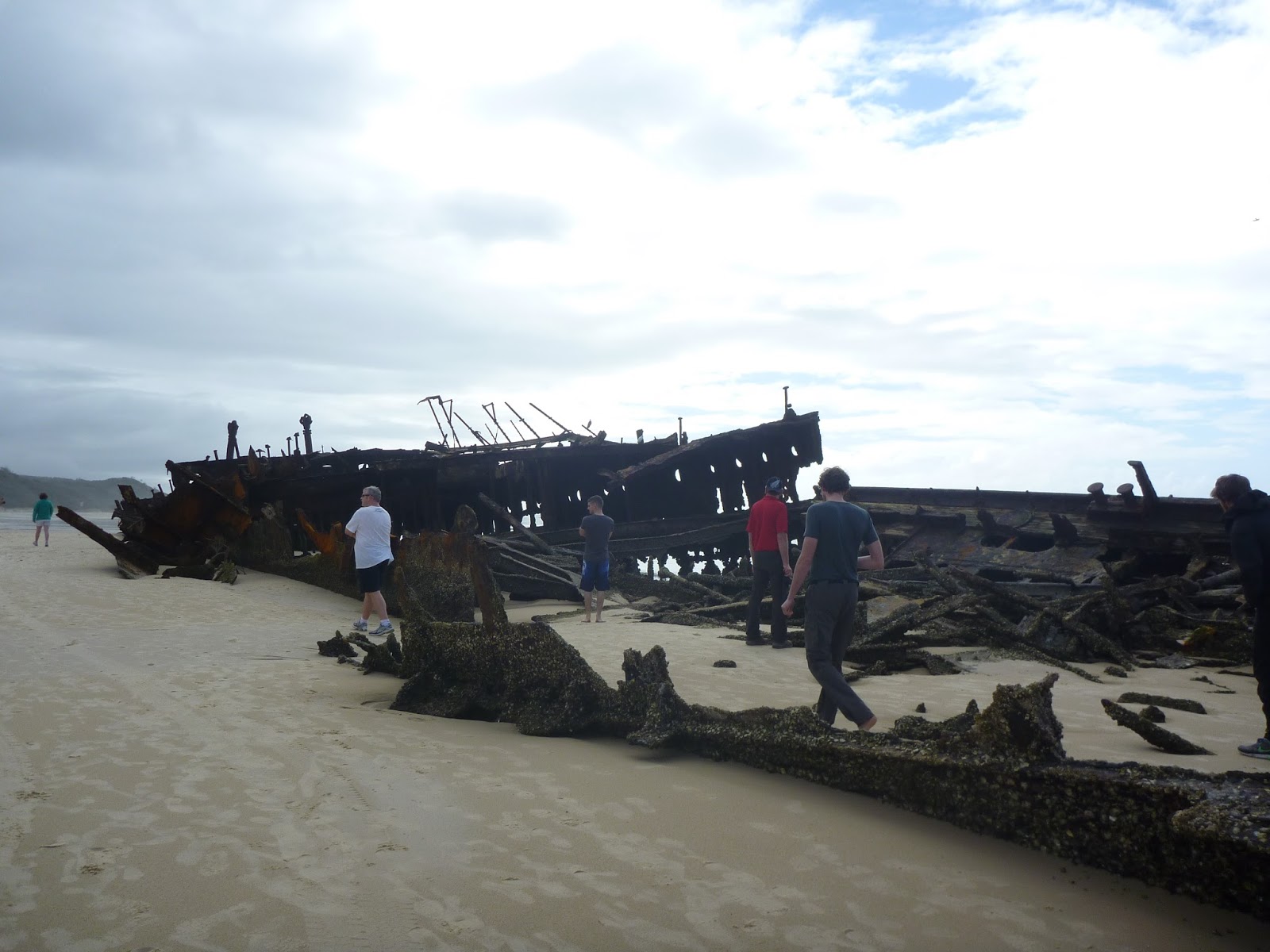
We had to make one detour off the beach at Yidney Rocks as the waves were crashing over the rocks and it wasn’t possible to drive around the point.  There was a track leading up the sand dunes and drives through Happy Valley which has quite a few holiday homes and accommodation with a general store.  The detour is quite short and soon we were back down on the beach heading north.  We bypassed Eli Creek (we returned the next day) and continued on to Maheno Wreck where our plans to continuing just driving north were forgotten.  The wreck is so amazing we found it impossible to just drive past, and secondly we would have had to drive on the airplane runway. 


The ship, the Maheno was a New Zealand ship (originally built in Scotland in 1904) initially sailing trans-Atlantic for several years and during WW I was a hospital ship.  After WW I it sailed the trans-Tasman route between Sydney and New Zealand.  It was eventually sold to a Japanese company who, low on cash, sold the huge brass propellers from under the still working Maheno to help fund the journey to Japan where the plan was to be melted down and sold as scrap metal.  An unseasonal cyclone hit off the coast of Fraser Island and the ship wrecked in July 1935.  Fortunately there was only a skeleton staff of Japanese on the ship and no lives were lost and the eight sailors on board were found camped on Fraser Island.  The wreck is now seen by thousands of tourists every year and is amazing to see but because of the rusty condition access on to the wreck is prohibited.


Lake McKenzie and Kingfisher Resort


As our planned trip along the beach did not eventuate we moved on to plan B and took the inland road we had earlier crossed from the barge as far as the turn off to Lake McKenzie.  Here the road deteriorated somewhat (and in fact a couple of days later was closed to all traffic) and we apologise that the photos are not great.  These were taken as we travelled (bumped and rock n rolled) and it was better not to stop because of the chance of other vehicles on the track.  The speed limit on all tracks on the island is 30 kph which was not surprising.
 The lake is really interesting as it has no stream, river or under water feeds but is rain filled.  It evaporates during hot weather but fills again with good rainfall.  There is a hard lake bottom created by thousands of years of decaying plant matter and the quality of the water is maintained by this base and the living things in and around the lake.

There are a number of picnic facilities at the lake but the really interesting thing about these facilities were that they were contained within fence lines.  Signage clearly said that there was to be no food preparation or consumption outside of the fenced areas.  This was because this is dingo territory and the dingo are attracted by the food and become a problem to visitors.  We didn’t see any dingo during our visit to Lake McKenzie but that is not to say that they didn’t see us.

There were quite a few other people at the lake when we were there as there were a number of the small 4wd tourist buses there – not ideal for us so back on the road and we continued on to Kingfisher Resort.  This resort is the more up class resort of the two, both with the same owners, and is on the west of the island.  There is a barge direct to Kingfisher Resort but when talking to one of the tour bus drivers he said that it is annoying as they have to travel the same 30-45 minute track both directions each day to get to the east side of the island where beach driving and the sights are.  The track was really corrugated in parts and in other parts with deep soft sand and certainly took careful driving.  This is the only track to the resort as there is no beach side driving on the west side of the island.  Kingfisher Resort is certainly upmarket to Eurong and appeared to have a variety of types of accommodation including individual villas.  They are set up the hillside.  We walked out on the jetty where there were a number of people fishing, and watched a group with kayaks.  We stopped off at the outdoor bar and pizza area and then hit the road again and bounced our way back to where we were staying.

 Our booking at Eurong Beach Resort included buffet breakfast and dinner – it was nice not to have to think what we were going to have for a meal.  If we were thinking the buffet would be similar to those of say Fiji or Malaysia we would have been sorely disappointed.  There was ample food but it was basic and served from a baine marie.  The tables and chairs were in a large dining area and it was a self-service affair.  Unfortunately I didn’t take a photo to share however, think of a school camp type dining room and you will have the picture.  The food service was for a couple of hours each time.  However, the waiting staff were very friendly, drinks were available from the bar and all the guests were very casual.  There was no evening entertainment and people soon wandered back to their accommodation and before long the dining room was empty.  The tour buses were also served their morning tea and lunches in the dining room along with the house guests.


Saturday, August 3, 2013

Our first view of Fraser Island


Fraser Island is also part of the Great Sandy National Park and it doesn’t take too much indecision to work out how it got its name (the national park also extends to the main land around Rainbow Beach to the south of Inskip Point where another barge also travels from).  Four wheel drive vehicles are required on the island to drive both the tracks and the beach highway.  Caravans are not recommended (although we did see a couple of outback types) but camper trailers and boats are reasonably popular.  We arrived at Fraser Island at Wanggoolba which is on the west of the island and followed the track to the eastern side to our accommodation at Eurong Beach Resort.   We soon realised why four wheel drive vehicles were necessary, and we were pleased we had already deflated the tyres.  The drive across the island takes about half an hour and is a sandy track through the rain forest – it is just beautiful and a great introduction to the variety of the landscapes on the island.  
Although it is possible to stop off at Central Station (a very popular camping spot and day area) or take side roads to various lakes and Kingfisher Bay (which is another barge landing area and resort) we continued direct across the island to Eurong Beach Resort.  We had read in a Trip Advisor review that the facilities looked as though they were built by the Soviets.  Well, that was a bit harsh but they were certainly built perhaps in the 1950-60’s so did not have the resort appearance we have all become accustomed too.  However, with showers about and rain forecast we were happy that we weren't erecting the tent.


The staff members at reception were very friendly and welcoming and we were soon in our room – a reasonable size room with full kitchen facilities, obviously bathroom and sliding doors on to the deck overlooking the pool area, reception with the coast in the distance.  Yes, it could be considered a bit tired and not modern but was beautifully clean so what more could we really ask for.  One big advantage – the room was a reasonable size so out came the tent and although not erected in our room (that would have surprised the hotel staff) we were able to spread it out and complete the drying process.

As well as the resort, Eurong is the village area for the island.  There is a general store with fuel, bakery (with very nice offerings and at reasonable costs) and pizza shop.  All of these outlets were owned by the resort but as there were limited other shops were very popular.  After a bite for lunch we decided that we needed to drive on the beach – after all isn’t that what most people come to Fraser Island for?  The recommendations are that the beach highway is driveable two hours either side of low tide.  We collected a summary of the tide conditions and after a quick check realised that we were within the two hours of high tide and not the best time to drive on the beach.  However, we had time for our first adventure so down the beach we went hoping that we would make it to Dilli Village and then be able to take the inland road back to Eurong.  However about five kilometres down the beach we decided that we didn’t want to take any risks, and with few other vehicles on the beach, it would be better to turn around and get ourselves away from the incoming tide.